How Does Hip Extension Affect Your Running Technique?
In this article, I'm going to look at the importance of hip extension in running gait.
How important is the "hip drive" aspect in your running technique, when it comes to keeping you running injury-free?
Let's discuss...
Hip Biomechanics & Running Injuries
Many runners are too quick to look at the foot, and footwear, as being the source of many running injuries.
However, the fact is, that their problems often stem from issues further up the kinetic chain. Frequently, we can trace the biomechanical cause of many (but of course not all) running injuries to poor biomechanics around the hips and pelvis.
Looking back at over a decade of assessing the running biomechanics of injured runners, a pattern is clear to see. While sometimes there is a problem at foot-level that needs addressing, far more frequently runners need to work on the quality of movement coming from their hips during running gait.
Promoting good hip function, including a focus on mobility, stability and strength of the surrounding muscles (dealing with glute inhibition for example), is hugely important for you to achieve proper running form.
In this article, I'm discussing hip extension. However, identifying and dealing with restricted hip internal rotation is equally important - check out this related article on internal rotation of the hip...
Why is Hip Extension Important for Runners?
The propulsive actions in running gait come together to create a global (whole body) extension pattern.
Here's a link to a video if you want to quickly refresh yourself on the running gait cycle.
From the point during running gait known as "midstance", which is the point at which your standing foot passes beneath your hips, the task is to create a strong propulsive drive to push you onto the next stride.
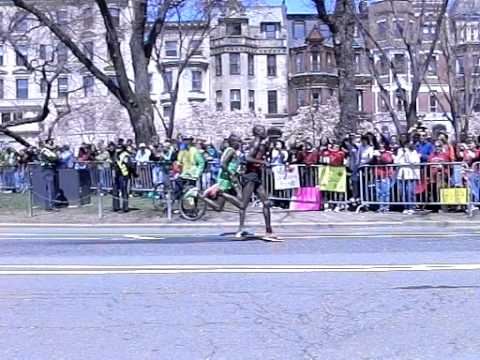
This propulsion is effectively created by you pushing the ground away, behind your forward moving centre of mass. We can clearly see great examples of this propulsive extension pattern in many elite distance runners.
Look at many elite runners: their ability to extend powerfully through a large range of hip extension motion before the foot leaves the ground is largely the reason for their huge stride length. The potential energy stored in their hip flexor muscles and tendons during this powerful hip extension enables the impressive elastic recoil in their efficient recovery phase (heel-to-butt motion).
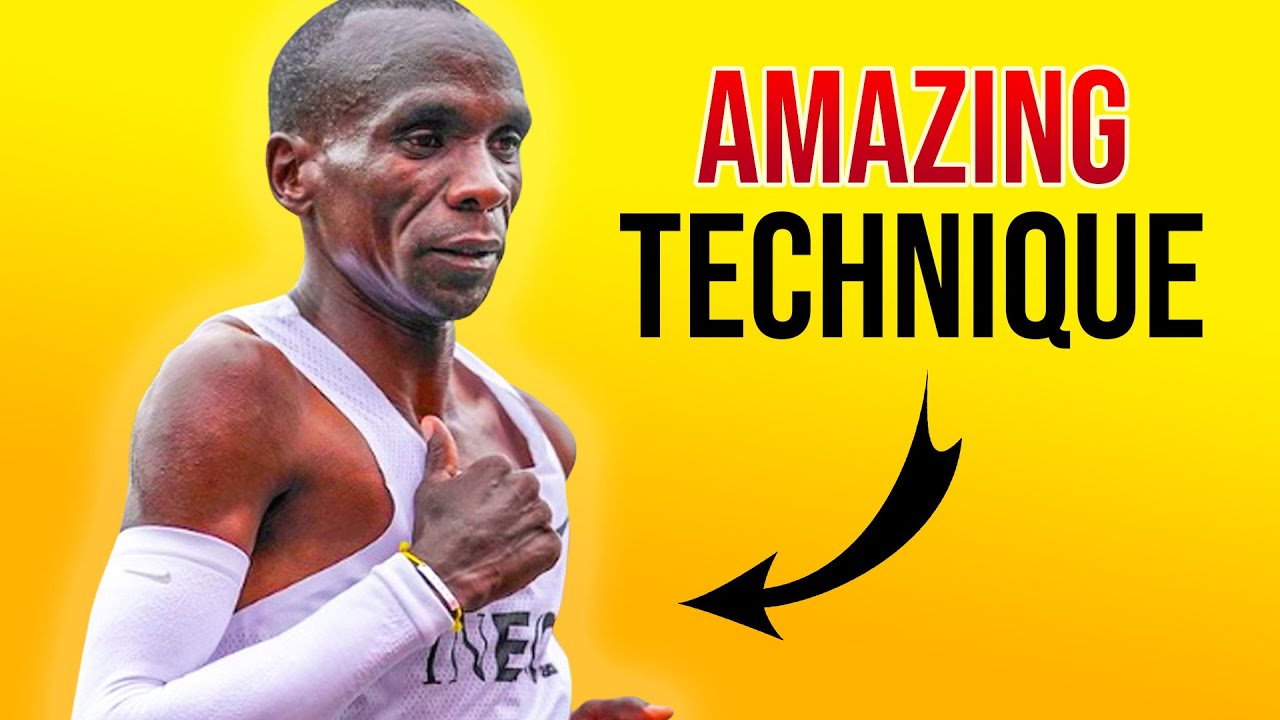
Where running pace is governed largely by the combination of stride length and stride frequency (running cadence), it's clear that the ability to extend well through the propulsive phase is a vital key to developing running speed and efficiency.
Propulsion during running gait
As with so many athletic movements like jumping and even Olympic lifting, the term triple extension applies in running gait. This term refers to the concurrent extension of the hip, knee and ankle.
In running gait, we need this triple extension to be driven top-down from the hip, with gluteus maximus and the hamstrings contracting powerfully to drive the femur (thigh bone) backwards from the hip. For this hip extension pattern to be most effective, we need stability and control around the pelvic region, to provide a stable base.
When it comes to core stability for runners, one of the most important concepts to work on is your ability to move through the many actions of running gait while keeping the motion of the pelvis controlled in all three planes of motion. This is often referred to as maintaining a neutral pelvic position.
The pelvic region is a real crossroads for forces acting across your body as you run. It's articulations with the sacrum and thus lumbar spine dictate much of the position and movement of the trunk during running gait. The pelvis provides origin and insertion points for a whole host of important muscles, responsible for both movement and stability.
If your pelvis is pulled out of this optimal "neutral" position by a soft tissue restriction, such as tightness in your hip flexors, many of it's attaching muscles are subsequently positioned in a disadvantaged position, and cannot effectively fulfil their role.
Remember, the vast majority of muscles function best in a relatively mid-range position. This is certainly true for gluteus maximus. By maintaining pelvic neutral as we run, this allows such muscles to fulfil their proper function.
Why is Triple Extension Important for Runners?
Running with good technique requires an adequate degree of triple extension to create the necessary stride length for the given running pace. We now know that this triple extension pattern should largely come from the hip, acting on a neutral pelvis. This controlled neutral position of the pelvis allows the powerful hip extensor muscles (glutes and hamstrings) to function properly, creating propulsion through mid-to-late stance - driving us forwards.
A huge issue impeding this triple extension in runners is the 21st-century lifestyles we live. Most of us spend so much time sitting down from day to day. We spend hour after hour in a flexion posture - the complete opposite to the extension required for proper running form!
We sit at desks, in the car, and on the sofa. If we're "lucky", we get to sit on the train (fellow Londoners know what I mean!) and in our leisure time, many of us like to sit on our bikes.
Eight hours a day in a seated position takes its toll. This plays a large role in developing soft tissue restrictions in the hip flexors and quads. Most frequently in runners, I see this manifested as tightness in the rectus femoris muscle of the quads and hip flexors.
Somebody once told me that "the human body does best, what it does most often". I think that's an appropriate phrase to use here.
If you spend all day in hip flexion, don't expect to be any good at hip extension.
That is unless you offset the "damage" done to our movement patterns by prolonged time stuck in hip flexion with lots of stretches and activation exercises working into hip extension.
As an aside, it might be an interesting exercise to track the amount of time you spend sitting each day. The results might scare you!
Issues Created by Poor Hip Extension
If you lack either the hip extension or pelvic control to effectively make use of the hip extension you have, there are a few issues that can present themselves when you run.
At best, it'll be harder for you to increase stride length sufficiently to realise your true potential pace while remaining efficient.
However, when it comes to movement, us humans have a remarkable ability to cheat and find ways to "get the job done"!
Sometimes though, this ability can backfire on us...
If a runner becomes restricted into hip extension, due to tightness in rectus femoris, for example, the triple extension required to create the desired stride length will instead most likely come from the pelvis being pulled excessively into an anteriorly rotated position, causing increased extension (arching) of the lumbar spine.
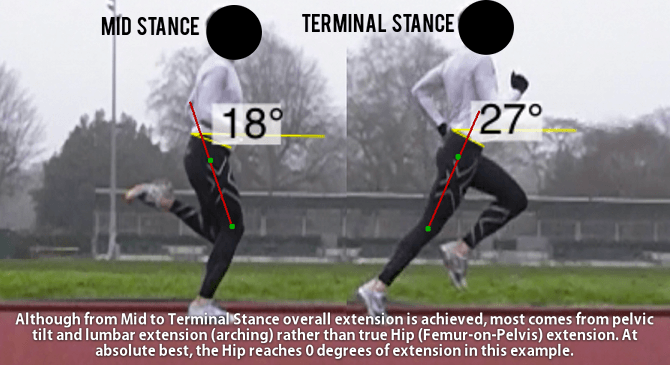
As described above, such dynamic changes in pelvic position result in important muscle groups being biomechanically disadvantaged and/or inhibited.
Often it's the glute complex of muscles are affected in this way, preventing them from functioning properly (more on glute inhibition here).
This compromised gluteal function sets the runner up for a whole plethora of potential problems, including knee injuries, back pain and, in my experience, injuries to the calf, achilles tendon, foot and lower leg.
Running Injuries Caused by Hip Restriction
Over the years working with many runners, I've noticed a real correlation between runners being unable to achieve the required glute-powered hip drive during running gait (due to tight hip flexors) and calf injuries, achilles tendon injuries and plantar fasciitis.
I like to explain this in saying that when a runner can't achieve propulsion from the hips (i.e glutes and hamstrings), a disproportionate amount of propulsion is created by the plantar flexors (the calf complex) at the ankle.
Runners compensating in this way to "get the job done" end up pushing-off excessively at the ankle during late stance phase, placing more demand on the plantar flexors of the ankle, the calf complex.
Anatomically, the plantar flexors are clearly structured in such a way to contribute to propulsion through the foot and ankle during running gait, but certainly not to take too great a role in creating this propulsion. the glutes and the plantar flexors work best in concert, sharing the propulsive load.
When the glutes are inhibited by either restriction around the hips, or poor pelvic control, the plantar flexor group picks up the slack in terms of propulsive effort.
This situation can manifest itself as chronic calf tightness, achilles tendon injuries, or even injuries like plantar fasciitis and shin splints.
If you're currently injured; hopefully this description will get you thinking about what you could perhaps work in terms of your running form as you work through your return to running plan.
Hip Extension Exercises for Runners
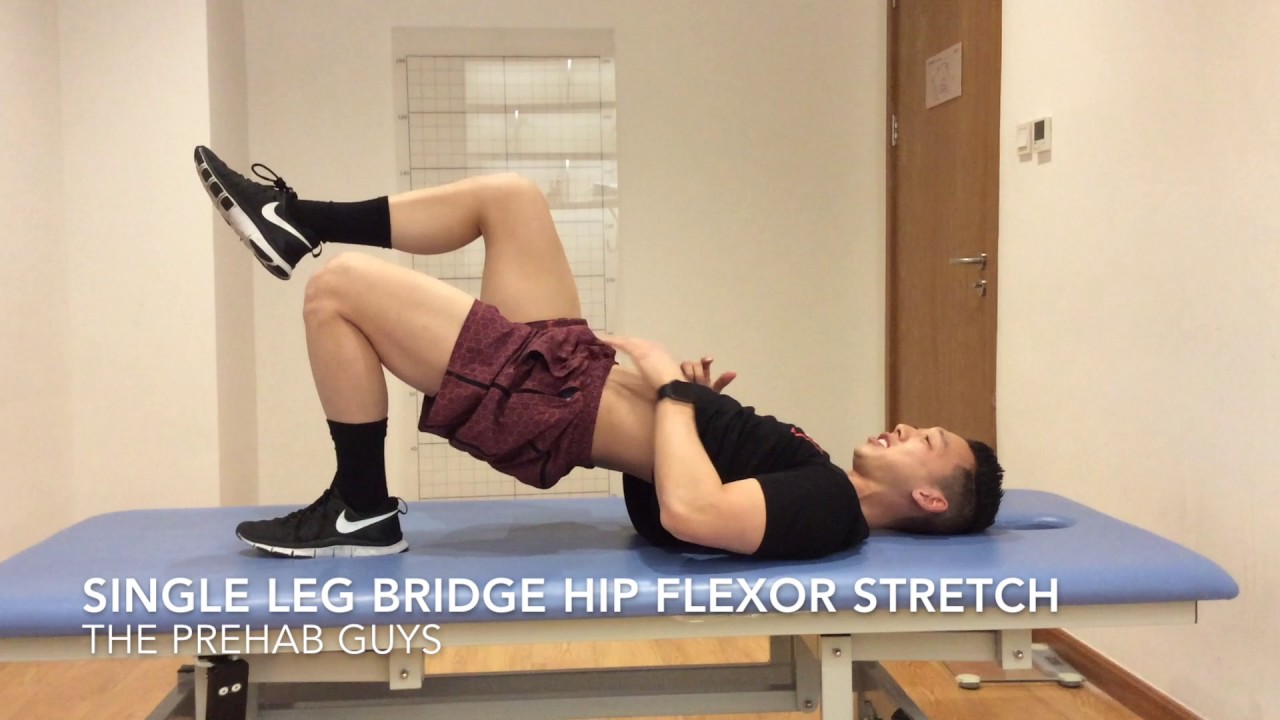
There are a few key hip extension exercises you can regularly practice to help not only increase hip mobility, but also develop glute activation through the important extension pattern. Feel free to add these to your regular running strength training regime as part of your marathon training plan, or half marathon running schedule.
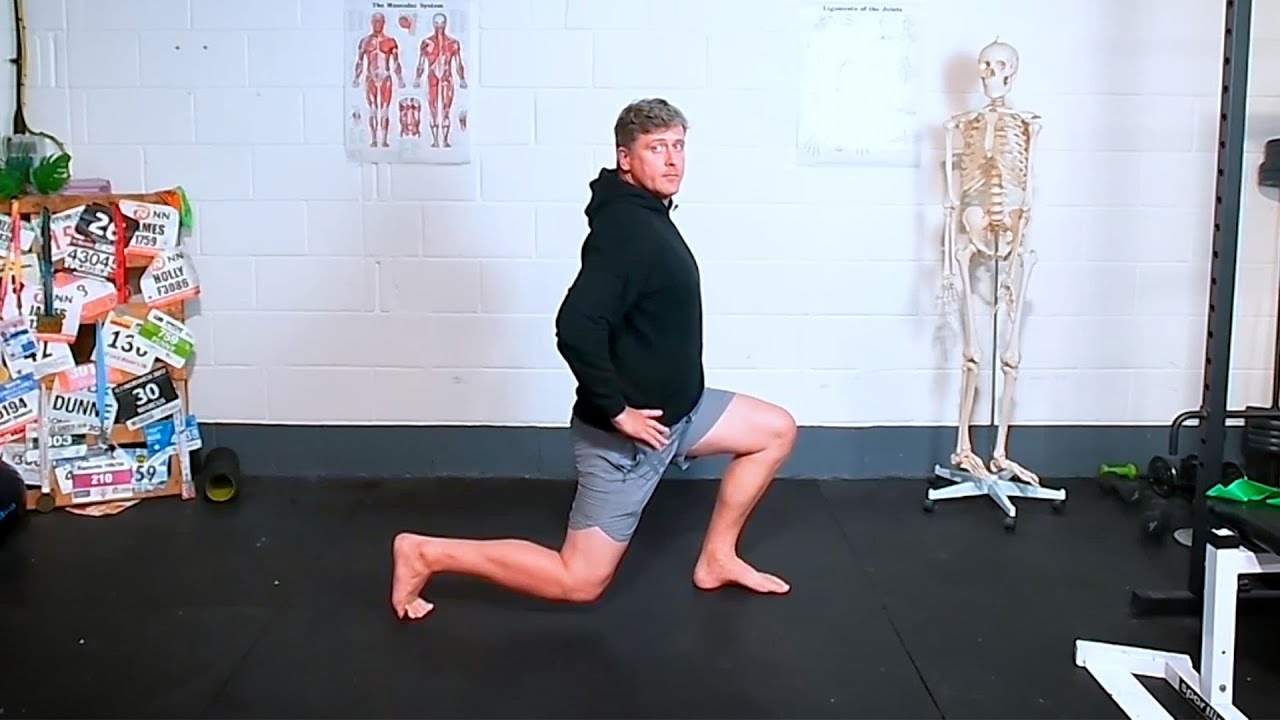
Hip Flexor Stretch
Single Leg Glute Bridge