How to Treat Calf Pain After Running
Tips to Prevent Sore Calves After Running
If you're currently struggling with calf pain caused by running, I hope the info I have to share in the article will help you treat your calf injury more effectively, and get you back to running as soon as possible.
In this article, I'll be looking at:
- The various common causes for calf injuries in runners
- Differing levels of severity of calf muscle injuries, and how to tell which you have
- How to treat your calf pain, and strengthen your calves so that you prevent a calf pain in the future
To begin with, let's take a look at some of the common reasons why the calf muscles become overloaded in distance runners, resulting in calf pain and injury.
What Causes Calf Pain After Running?
One of the more common injuries resulting in calf pain after running is a calf strain or a tear. The biggest of the calf muscles, Gastrocnemius to use its correct name, is the largest and most superficial of the muscles in the lower leg and is loaded repetitively and heavily during running sports.
With every stride we take when running, the calf gets loaded, firstly to absorb the shock of our body weight landing, then to help propel us forward into the next stride.
Now take into account that for every mile we run we take in the region of 1500 strides. Looking at it like this makes it easier to see that if there's a weakness in the calf complex, or a fault elsewhere in the kinetic chain or running technique which leads to more stress being experienced by the calf complex, the potential for calf pain and injury is almost certainly increased.
Broadly speaking, the muscles of the calf have roles more related to creating stability and control of motion around the foot and ankle, rather than creating big, powerful movements. I've written elsewhere in this website about a common pattern I see in runners where poor hip function leads to 'calf overload':
Another common pattern I see is where runners suffer calf injuries when trying to rush the process of adapting to forefoot running too quickly.
Often a poor warm-up is cited as a reason why runners suffer calf pain and injury. Most of us appreciate the necessity for a thorough running warm-up, but of course we often learn the hard way!
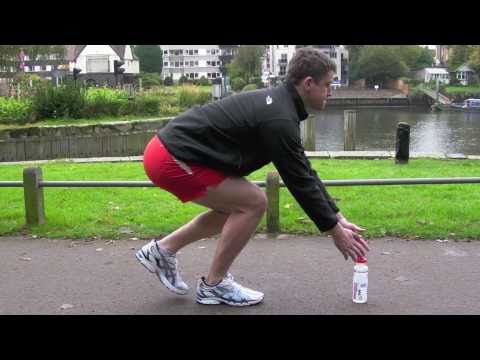
Dynamic Calf Warm-Up for Running
Let's consider why, in the case of the calf complex particularly, a good warm us is important in avoiding injury: The calf runs down from its medial and lateral attachments above the knee and blends with the achilles tendon – which in turn attaches at the base of the heel.
The calf and the achilles tendon act as one dynamic structure during motion. As the calf complex is loaded, a portion of the load is taken by the elastic properties of the achilles tendon, sharing the load with the calf muscles. If the achilles tendon is not warmed up sufficiently, these elastic properties of the achilles tendon will not be displayed and more of the load will have to be taken by the calf.
It is also important to note that as we age, these elastic properties of the tendons in general diminish – thus accounting for the increased occurrence of calf strains in the more senior of our athletic population.

Grades of calf strain or calf tear:
Muscular strains and tears are classified according to their severity in terms of how many fibres have been disrupted or ruptured
Grade 1 Calf Strain:
This is the least severe of calf injuries. A small number of muscle fibres have been damaged within the muscle. Signs and symptoms of this type of less serious strain may not be noticed until cessation of the activity. Tightness, cramping feelings and slight soreness are common when the muscle is stretched.
Grade 2 Calf Tear:
This is sometimes referred to as a partial calf tear. A greater number of muscle fibres have been torn, however the muscle remains largely intact. More immediate localised calf pain is present during activity, especially walking and running. Often the area is sore to touch.
Grade 3 Calf Rupture:
Total rupture. All the muscle fibres have been torn, losing continuity throughout the muscle. This is a serious injury and highly disabling. The athlete will be unable to walk pain free. Often bruising will appear below the tear site and there may well be a palpable bulge where the calf muscle has recoiled upon itself.
Calf Strain Treatment & Rehabilitation:
If you have a history of repeated calf strains, I'm sure you'll find my 12 week calf strengthening programme for runners really helpful.
Treatment of most calf injuries is initially much the same as that of any soft tissue injury. The Rest, Ice, Compression, Elevation (R.I.C.E) principal should be followed. Then a gradual return to exercise undertaken. Sports massage is also good once the initial acute phase has passed. In terms of timescales for rest, a good rule of thumb is 3 weeks for a grade 1 strain and 4-6 weeks for a grade 2 strain. A grade 3 tear will most likely require surgery followed by a twelve-week rehabilitation programme.
As with any injury, on the road to recovery, progressive and comprehensive exercise-based rehabilitation is key to avoiding recurrence or secondary injuries. These often occur through compensatory movements which may have become habitual during the injured period.
As with any injury, the rehabilitation phase is an ideal opportunity to target those areas we all ignore in our weekly training routine. The core muscles and glute muscles are a great place to turn focus to when you are restricted in terms of activity. The stronger these muscles can become, the more likely a successful outcome is to be reached both in terms of injury recovery and subsequent performance.
Particularly after an injury to the leg, the first step in the rehabilitation process is to correct any limp that may remain after the pain has gone. These limps become habitual both in running and in walking and can cause problems in areas such as the lower back.
Specific single-leg exercises are important to build the strength in the injured limb and take away the temptation to use the other leg to bear an uneven portion of the load. These exercises also enable the body to regain its sense of balance which will have been lost on the injured side during the injury period.
Once improvements have been made in single leg strength and balance, low-level plyometric exercises may be re-introduced as a precursor to running. Jumping, hopping and skipping are all useful to re-introduce the muscle to the dynamic loading needed for running.
Once successfully progressed through the multidirectional plyometric exercises, running may be re-introduced in short bursts. A sure way to re-injure the muscle is to do too much too soon at this stage. Running is to be approached with a methodical approach in terms of progressing from session to session. Keep a watchful eye on running technique – especially foot position on contact.
Begin with straight line runs with gradual acceleration and deceleration. Then slowly introduce changes of direction and more aggressive changes of pace.

How to Prevent Calf Pain After Running:
The following exercises will help you build strength and stability to prevent calf pain after running.
Single Leg Squat
Balancing on one leg, flex at the hip, knee and the ankle performing a mini squat keeping the knee aligned with the first two toes, then return to the standing position. Repeat this maintaining alignment of the knee.
Calf Raise
Start standing with the heels hanging off a step, with your body weight supported on the balls of the feet. Slowly allow the heels to drop towards the ground, coming below the height of the toes, then rise up using the calves so that the heels come higher than the toes.
Calf Stretches
With one foot far in front of the other, and hands pushing on the wall, keep the rear leg straight and flex the front knee. Pushing the rear heel into the ground, a strong calf stretch should be felt in the rear leg.
Wobble Cushion Balance
Balancing in a single leg stance on any unstable surface. Begin with a reasonably stable surface, and progress by increasing time or decreasing stability.
Jumps
Staying ‘light’ and landing on the forefoot, jumps are a great way of re-introducing the calf complex to more dynamic loading. Begin with a set of 10 jumps on the spot. Then progress to doing as many jumps between one spot and another for 20 seconds. Further progression entails adding multidirectional jumps in all planes of motion.
Hops
Following the same methodology as that used when progressing through the jumps program: perform these dynamic motions as hops – preventing the body from compensating through using the uninvolved leg.
Good luck with the recovery from your calf pain. I'm sure that with time spent working on these exercises and other similar rehab routines, you will get back to running without calf pain.