Achilles Tendon Injuries: Know the Warning Signs
What are the early signs of an achilles tendon injury?
In this article, you'll learn some of the most common patterns I've seen in my years of treating injured runners, dealing with Achilles tendinopathy. I'll help you know what to look-out for in terms of early warning signs, to help you prevent a small Achilles ache becoming a bigger problem, such as a full Achilles rupture.
One of the most frustrating things about of many of the Achilles tendon overuse injuries I see, such as Achilles tendinopathy, is that the majority of them appear to "come out of nowhere", at least from the runner's perspective.
There's no acute injury that we can point to and say "this is what happened"! There's no dramatic pop or tearing sensation as you might expect from a muscle tear.
There's just a gradual onset of pain and stiffness that worsens over time. Sometimes the symptoms start well after a workout, while we're sitting at home on the couch or driving home from the track.
Sounds frustrating, right?
Wrong! There ARE actually warning signs along the way.
Usually, the warning signs of Achilles tendinopathy is far more subtle than a feeling that your Achilles is about to snap!
We're all just programmed to see these early signs of achilles injury as "normal" training aches and pains and ignore them, or just pass them off as "my achilles feels a bit weird".
Before we go any further, let's quickly recap the anatomy of the Achilles tendon.
Where is the Achilles tendon?
The Achilles tendon is found at the rear of your ankle region. It is a thick, strong tissue that connects the muscles of the calf complex to the calcaneus (heel) bone.
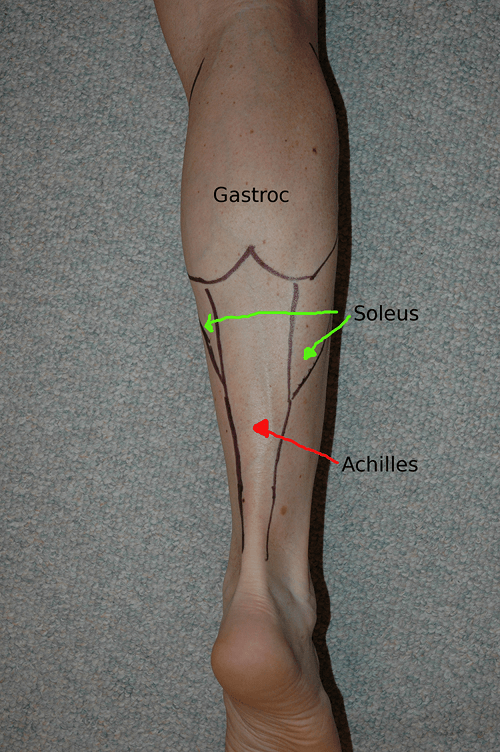
The big thing to remember about the Achilles tendon (and the calf in general for that matter) is that there are two calf muscles that share the tendon. Most athletes are familiar with the larger Gastroc muscle because we can all see it. The smaller Soleus muscle, however, gets forgotten more often than not. The Posterior tibialis which is located under both of them on the inside of the lower leg is even easier to forget.
My main point in bringing up the anatomy is that the lower leg is a busy place. You have a good mix of large and small muscles and imbalances in just one of those can cause all kinds of problems.

What do Achilles Tendon injuries look like in the early stages?
Here's a selection of some of the common "early warning" signs that I often see as a pattern in runners who have gone on to struggle with Achilles tendonitis.
1. Sore Achilles tendon in the morning
Have you ever gotten out of bed in the morning and felt like your feet and ankles don't move at all for the first few steps? It's like having blocks for feet?
A common early warning sign of Achilles tendonitis is a feeling of stiffness or pain in the Achilles tendon itself first thing in the morning.
Your steps are loud and you have this short little stride instead of a normal step. The first time down the stairs might be tricky or result in you having to turn your feet sideways a bit. It loosens up once we're up and about which is why we tend to overlook it, but the truth is that this is a warning sign.

When we sleep, most of us have our ankles pointed down for 6-8 hours at a time. This allows the calf to tighten up. Normally, it's not enough to cause "block feet" in the mornings but if you already have a good amount of tightness in those muscles, it can be just enough to make that a problem.
2. New Foot Calluses Forming
New blister and callus patterns are a great warning sign that your foot is working harder than it should be. This is typically common under the big toe or along the outer ridge of the foot.
An easy way to look at it is this. When the foot makes contact, it "rolls" to absorb impact and transfer it from the outer part of the foot over to the big toe to prepare for push off/propulsion. This allows the ankle and calf to do the heavy lifting. If you're getting new blisters in the same spots or calluses, then something is off and that foot is "rolling" more/less than it should.
3. Scuffing Your Toes or Clipping the Inside of Your Ankle
These are both warning signs that things are off in the lower leg/foot. Scuffing your toes or tripping over that "invisible speed bump" is a sign that your push off isn't working. In a nice, strong push off the toes are cleared as the leg swings up. It's a relaxed motion that requires zero energy on our part. When we don't have that, we have to pull our toes and ankles up so we don't fall over them.
The muscles along the front of the shin that do that, unfortunately, aren't designed to maintain that function and eventually will start to fail. When they do, the scuffing starts.
Likewise, if you find yourself clipping the insides of your ankles with your shoe, that's a warning sign. When the leg swings through after that push off, it swings through nice and straight. If you're catching the inside of your leg/ankle, again something is out of balance.
Listen to Your Body
The great thing about warning signs is just that! They warn us that we need to start paying attention.
If you find yourself experiencing any of the signs above, here are a few tips to start loosening up those calves and ankles, to allow your Achilles to function properly.
If you're struggling a stiff Achilles tendon due to tight calf muscles, try this simple foam roller routine for calf tightness:
You can pick up a foam roller on Amazon via this link!
Here are some tips to walk you through a session with the roller using three techniques.
- Typically I start off with 2-3 minutes with the foam roller. The goal here isn't to beat my calves up. It's to get some slack in there and find where the "problem spots" are (aka where it hurts the most). Once I've narrowed it down to those, then I like to dig a little deeper with a tennis ball using the cross friction/trigger point techniques. Both of these are described in the link above.
- From there I like to use mobilizations to free up the ankle itself, and then further mobilizing techniques to get in and work the calves and the Achilles tendon itself.
- Lastly, I always follow it up with stretching. Frequency trumps everything with these. Aim to get in 1-2 reps every few hours versus one killer stretch session at the end of the day. Here's a video to walk you through the stretch routine.
Pre-Run Achilles Warm-Up
One of my favourite exercises to help warm-up the Achilles tendon and calf complex as a whole, is this dynamic drill:
Dynamic Calf & Achilles Warm-Up for Runners - Click here to try this simple drill
You can also try some hands-on soft-tissue techniques to self-treat your Achilles pain: