Don't Believe The Heel Strike Hype
I've been banging on for quite some time now about my frustration with the running and triathlon media. Far too frequently I read yet another ill informed article describing running with a forefoot or midfoot strike as the universal solution to unlocking your most efficient, injury-free running form.
Many of these articles seem to paint a very black and white picture, that running with a heel strike is bad, and should be avoided if you want to run to your potential.
I get it. There's no doubt currently something cool for magazines to be writing about barefoot, minimalist, midfoot or forefoot running, and the technique encouraged by these styles. The influential running footwear manufacturers with minimalist products to sell, will of course also be keen for such pieces to be written!
Unfortunately though, life (and in particular running gait) isn't ever about one size fits all solutions...
As my colleague Ian Griffiths would say:
"Nothing works for all of the people, all of the time"
Not All Heel Strikes Are Equal
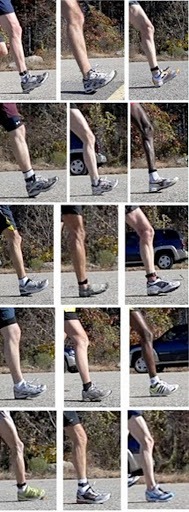
What I find most interesting is that while some varieties of heel strike are indeed bad news, with the runner typically over striding, landing heavily on the heel and taking maximal impact loading rate through the rear-foot, other (less aggressive) varieties of heel strike appear to facilitate an effective midfoot loading - despite the initial contact with the ground visibly occurring at the heel.
This variation in heel strikes and the subsequent loading patterns, is particularly highlighted in research discussed by Dr. Pete Larson on his blog recently. The variation in heel strikes within the running population is well demonstrated visually by his great compilation of race photos (below) from the 2009 Manchester City Marathon.
Image sourced with permission from Runblogger.com
Research from Bastiaan et.al. (2013) suggests that up to 25-33% of visibly heel striking runners don’t really experience any significant loading as their rear-foot (heel) contacts the ground, with their foot instead loading maximally in a midfoot position. Of course, with a sample size of 55 healthy runners, making assumptions about the whole running population based on this research alone is questionable.
I do however see the effect of this variation in heel strikes on a very regular basis in coaching distance runners and triathletes. Simply adjusting variables such as cadence and posture can alter the loading of a runner's heel strike, without actually preventing them from heel striking per se.
Coaching Implications
I posted an article a while ago about Forefoot Running for Ironman Athletes, describing the logic behind why I often advise and coach habitually heel striking Ironman triathletes (and indeed those training to run a marathon) not to worry too much about perfecting a midfoot / forefoot strike - instead to spend time and effort optimising their heel strike.
Both research and anecdotal experience suggest that even if a habitually heel striking runner starts a marathon (for example) with a midfoot or forefoot striking pattern, chances are that they will often revert back to heel striking to some extent as the race distance progresses. This 'reverting to type' may be down to a drop in cadence as fatigue kicks in, or lack of strength endurance in the plantar flexor muscles.
Bearing this in mind, I often prefer to coach a habitual heel striking distance runner or triathlete to achieve a light, glancing heel strike (sometimes referred to as a proprioceptive heel strike), encouraging a more achievable midfoot loading, without requiring the conscious cue of landing on the balls of the feet.
Working in this way to promote positive changes within a strike pattern the athlete's body is already familiar with, seems to be far more successful and achievable in many cases, than making wholesale changes to the strike pattern!
Trading a heavy over striding heel strike, for a lighter glancing heel strike with a slightly increased cadence and better posture, is far less of a shock to the system than trading a heavy over striding heel strike, for an unsustainably forced midfoot or forefoot strike... But then other athletes will thrive with a midfoot or forefoot strike; that's the challenge of coaching!