Piriformis Syndrome: Symptoms, Causes, Treatment & Prevention
Quite some time ago now I posted one of my favourite stretches for runners to ease the often painful symptoms of piriformis syndrome.
In the new video above, I discuss some of the main causes of piriformis syndrome in runners, as well as the importance of addressing the root of the injury, not just the symptoms!
What is Piriformis Syndrome?
Piriformis syndrome is a relatively common injury amongst runners, where the piriformis muscle, gets chronically tight and creates pain either locally to its position in the buttock region, or pain referring down the path of the sciatic nerve into the back of the thigh. This sciatic pain can also sometimes be felt lower in the leg and down into the foot.
There are a number of conditions that can cause pain in the piriformis region, such as lumbar disc herniations. This sometimes causes cases of piriformis syndrome to be initially misdiagnosed.
However, there are a set of typical characteristics that, if present, can help confirm piriformis syndrome as being the cause of your pain, or altered sensation such as numbness or 'pins and needles':
- Pain local to the buttock/piriformis region
- Specific tenderness between the sacrum and the top of the femur - the location of the piriformis muscle.
- Buttock and sciatica-like pain made worse with prolonged sitting
- Symptoms can be aggravated when the hip and leg is positioned to put tension on the piriformis muscle
Anatomy of Piriformis Syndrome
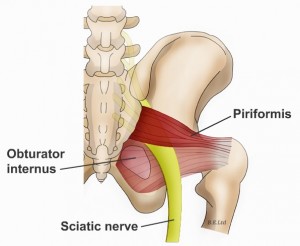
The piriformis muscle is positioned close to the hip joint, covered by the gluteal muscle group. It's often described as a deep buttock muscle. Piriformis runs from the sacrum (base of spine) to the outside of the top of the femur (thigh bone).
Anatomically its role is to help rotate your leg outward when your hip is extended, and to rotate your leg inward and into abduction when your hip is in deep flexion flexed.
The sciatic nerve is a very thick nerve which originates from your lumbar spine and passes through your glute muscles, down the backs of your legs, all the way down to your toes.
When it comes to the path of the sciatic nerve, there's a degree of anatomical variation amongst the population. The sciatic nerve passes directly beneath the piriformis muscle in most people, however, research has shown that for between 15%-20% of the population the nerve actually passes through the belly of the piriformis muscle.
What Causes Piriformis Syndrome?
The main cause of piriformis syndrome is sustained pressure between the sciatic nerve and piriformis muscle of the hip. This can occur for a number of reasons, including:
- Spasm of the piriformis muscle, potentially due to irritation of the piriformis muscle itself, or a local structure such as the sacroiliac joint. Often this is one of the body's protective mechanisms.
- Tightness (and potentially hypertrophy) of the piriformis muscle, due to increased physical demands on the muscle over time
In the case of most runners I have worked with over the years, it has been the case that piriformis has become tight as a result of the increased demand on the muscle, due to weak glutes and core muscles.
The gluteal muscles and muscles of the core region should provide stability to the hip, pelvis and lumbar spine region as we run. However, runners with weak glutes and core muscles will sometimes find that piriformis will become tight in an effort to provide the stability at the hip that would otherwise be coming from the gluteal muscles.
From a running technique perspective, one of the common biomechanical clues that a runner is weak through their glutes and/or core is the classic "hip drop" or Trendelenburg sign.
Hip Drop Running Gait: Causes & Simple Fixes <- Learn how to fix your "hip drop" and build hip stability...
If your hips drop from side-to-side as you run, and you suffer from piriformis syndrome, you will certainly need to work on glute medius strength and incorporate work for your oblique abdominal muscles into your rehab programme.
How Long Does it Take to Recover from Piriformis Syndrome?
Typically a mild case of piriformis syndrome can be successfully treated in 2-3 weeks, but more severe and irritable cases can take 6 weeks or longer.
Recovery from piriformis syndrome is rarely a linear process, so you can expect occasional flare-ups along the way. It is important to learn how to manage these instances using the piriformis syndrome exercises show below.
Many runners will, unfortunately, have had experience of piriformis syndrome hanging around for months, or even years. Often in such cases, the focus of the treatment they've experienced has been on on the symptoms, rather than the root cause.
Clearly, if you're in pain it's important for treatment to successfully ease your symptoms, but I can't emphasise strongly enough the importance of identifying weaknesses in your glutes and core region that probably caused the problem in the first place.
Fail to address these factors, and the chances of you experiencing another bout of piriformis syndrome when you return to running will be higher. We don't want that!
If your physio simply has you stretching, foam rolling, and "enjoying" regular hands-on treatment, be sure to ask them to give you some strengthening exercises to help you work on the weak links.

Can you run with Piriformis Syndrome?
The good news is that runners who suffer from piriformis syndrome don't always feel their symptoms when running. If running doesn't seem to irritate your symptoms, you can continue to run with piriformis syndrome. In fact, if your symptoms allow you to run, you may find that the movement of running helps your pain to ease.
Be sure to always perform a thorough warm-up incorporating gentle hip mobility drills and glute activation exercises.
However... be careful if you try to run with piriformis syndrome, and listen to your body. If you feel your pain worsening during a run be sure to stop.
Piriformis Syndrome Exercises
There are a number of great piriformis syndrome exercises you can perform at home, both to help ease the symptoms and to fix the weak links that cause the injury in the first place. These piriformis syndrome rehab exercises fall into four categories:
- Soft Tissue Treatment
- Hip Mobility Exercises
- Glute Activation & Hip Stability Exercises
- Neural Mobility Exercises
Soft Tissue Treatment for Piriformis Syndrome
Here's an example of a simple foam roller technique you can use to release the piriformis muscle and get relief from your piriformis syndrome symptoms.
Hip Mobility Exercises for Piriformis Syndrome
Below are two examples of simple hip mobility exercises you can use to stretch the piriformis muscle and get relief from your piriformis symptoms.
Glute Activation & Hip Stability Exercises for Piriformis Syndrome
It is important to work on glute activation and hip stability as part of your piriformis syndrome rehab plan. Below are two exercises to get you started.
Neural Mobility Exercises for Piriformis Syndrome
The neural slump exercise is a great drill you can use to improve neural mobility. Be gentle with this one, especially if your piriformis syndrome symptoms are quite easily aggravated.
With all of the piriformis rehab exercises listed above; if you are unsure, please consult your physio.
How to Heal Piriformis Syndrome Quickly
It's important to be proactive in your recovery from piriformis syndrome, and catch the warning signs early, before it becomes a chronic injury. If you are able to begin treatment as soon as you notice the buttock pain of piriformis syndrome, you should be able to recover quickly.
Lifestyle factors cannot be overlooked, as making small changes to your lifestlye can certainly make for a quicker recovery from piriformis syndrome. If, as is common for piriformis syndrome sufferers, you know that prolonged periods of sitting will tigger your symptoms, it is important to find ways to avoid this habit. Easier said than done, I appreciate.
Avoid sitting in seats which put you in deep hip flexion (hips below knees), as sitting in this position for prolonger periods may cause aggravation of your symptoms. Bucket seats in cars can be a problem, for example.
Employing some pattern recognition to figure out what activities and positions seem to cause aggravate your piriformis syndomre, and some lateral thinking to find alternative options, you can learn to manage your symptoms very effectively and speed-up your progress on the road to full recovery from piriformis syndrome.
Good luck!