Foot Strike and Injury Rates in Endurance Runners
[Updated August 2013]
He Who Shouts Loudest...
...should be heard with a healthy dose of scepticism?
A heavily publicised study released by Dr. Daniel Lieberman and his team at Harvard University in January 2012, retrospectively evaluated the injury statuses of a mixed sex collegiate cross country running squad of 52 athletes.
Researchers classified each runner in terms of foot strike pattern:
- Rear-foot (heel) strike
- Forefoot strike
The injuries reported by runners in each the two groups were recorded and evaluated.
Foot Strike and Injury Rates in Endurance Runners: a Retrospective Study
Purpose: This retrospective study tests if runners who habitually forefoot strike have different rates of injury than runners who habitually rearfoot strike.
Methods: We measured the strike characteristics of middle and long distance runners from a collegiate cross country team and quantified their history of injury, including the incidence and rate of specific injuries, the severity of each injury, and the rate of mild, moderate and severe injuries per mile run.
Results: Of the 52 runners studied, 36 (69%) primarily used a rear-foot strike and 16 (31%) primarily used a forefoot strike. Approximately 74% of runners experienced a moderate or severe injury each year, but those who habitually rear-foot strike had approximately twice the rate of repetitive stress injuries than individuals who habitually forefoot strike. Traumatic injury rates were not significantly different between the two groups. A generalized linear model showed that strike type, sex, race distance, and average miles per week each correlate significantly (p<0.01) with repetitive injury rates.
Conclusions: Competitive cross country runners on a college team incur high injury rates, but runners who habitually rearfoot strike have significantly higher rates of repetitive stress injury than those who mostly forefoot strike. This study does not test the causal bases for this general difference. One hypothesis, which requires further research, is that the absence of a marked impact peak in the ground reaction force during a forefoot strike compared to a rearfoot strike may contribute to lower rates of injuries in habitual forefoot strikers.
Key Points to Remember
Of the 52 strong group, 69% were heel striking runners and 31% forefoot strikers.
It turns out that 74% of the total group suffered significant running injury during the season - which roughly follows figures suggested by injury surveillance studies in endurance running.
The rear-foot (heel) strike group in this particular study suffered approximately double the rate of repetitive stress related running injuries, in comparison to the forefoot striking group.
MOST IMPORTANTLY PERHAPS:
This retrospective study focused on a very small sample size of elite level collegiate athletes. We almost certainly can't make generalisations about the wider running population from such a small cross-section of a tiny niche within the top performance levels of our all-inclusive sport.
I mean, how can these results seriously be relevant to your typical middle aged 4hr marathon runner?!
The bold conclusions drawn from this particular piece of research have been wildly blown out of all proportion by some of those with a stake in the minimalist market (see this RunBlogger.com article).
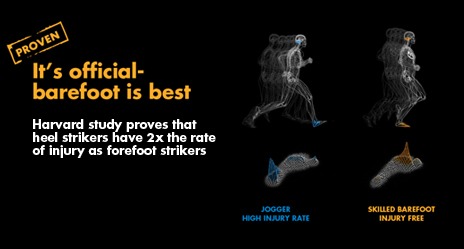
Vivobarefoot even jumped onboard the propaganda train with this hastily released advert... enough said!
Fast-Forward to August 2013...
Thankfully, we now have additional recent research to hold alongside the study mentioned above, and those that preceded it. This additional data helps us to build a better understanding of the 'big picture' when it comes to the potential links between running foot-strike patterns and injury.
Grier et.al. (2013) With a sample size of 1332 soldiers, 17% of which were running in minimalist footwear, no significant injury rate differences were observed between minimalist and traditional running shoe wearing groups. Unfortunately we have to assume that runners in the minimalist group were mainly non-heel strikers.
In another study using Army subjects Warr et.al. (2013) however did assess the foot-strike pattern of each of their 342 participants. No significant difference was found between the injury rates and days training lost from injury, between the heel striking runners and non-heel strikers.
General Conclusion
The overall consensus to date seems to in fact be, that no reasonable link can be proven between running strike pattern and injury rates.
Thanks to Craig Payne at RunResearchJunkie.com for keeping me up-to-date with this research!
My Coaching Perspective
As a coach I'm not pro or anti forefoot running, or indeed heel striking per se.
Both foot-strike patterns have their own merits and are appropriate for different types of runner.
The subject of running gait just isn't that simple when you're dealing with individual athletes and their individual dysfunctions, strengths and weaknesses.
In fact, some exciting (if you're into that kind of thing - I am) recent research suggests that a percentage of runners who visibly heel strike actually experience maximal rate loading at the midfoot, not the heel!!
FYI
Personally, I'm a forefoot/midfoot runner myself, and can 100% claim to have benefitted from switching gradually away from a heel striking style - it works for me.
From anecdotal experience, I would suggest that habitual forefoot strikers, and well adapted ex-heel strikers tend to experience fewer knee (particularly Patellofemoral Pain Syndrome) injuries, perhaps due to the reduced peak knee flexion angle in mid stance. Something that my colleague Brad Neal and I have been discussing a lot recently...
The Harvard research cited above suggests that the impact peak in ground reaction force seen in the heel striking loading pattern may be more injurious. However, what's so often not written about is how the impact peak cited in their study's conclusion section can also be greatly reduced by staying within the heel strike classification as a runner, and simply landing the heel strike closer to under the centre of mass... without having to make such a wholesale change as moving onto the forefoot - which can lead to injuries in it self.
If I'm working with an athlete who is strong enough to maintain a forefoot position, had an appropriate injury history, and was training for a suitable distance - I'd definitely encourage them to adopt a forefoot position. However, if I did this with every athlete I work with, there'd be some very broken runners leaving my care!
Then there's the importance of the type of runner you're dealing with (middle distance vs ultrarunner for example). Research by Pete Larson (@RunBlogger), published in 2011 entitled "Foot strike patterns of recreational and sub-elite runners in a long-distance road race" indicates that a significant proportion of those who start long distance (marathon) running events as midfoot/forefoot runners in the first 10km, often end up as heel strikers by the latter stages of the race.
More Research Needed
I'll be very interested to see if anybody continues the injury surveillance and biomechanical research to sub-categorise heel strikers.
The categories could be:
- Those who heel strike AND over-stride with a low cadence
- Those who heel strike and maintain a contact closer to under their centre of mass through keeping a relatively high cadence. Therefore still experiencing less impact without going the whole way to a forefoot strike.
All food for thought...